

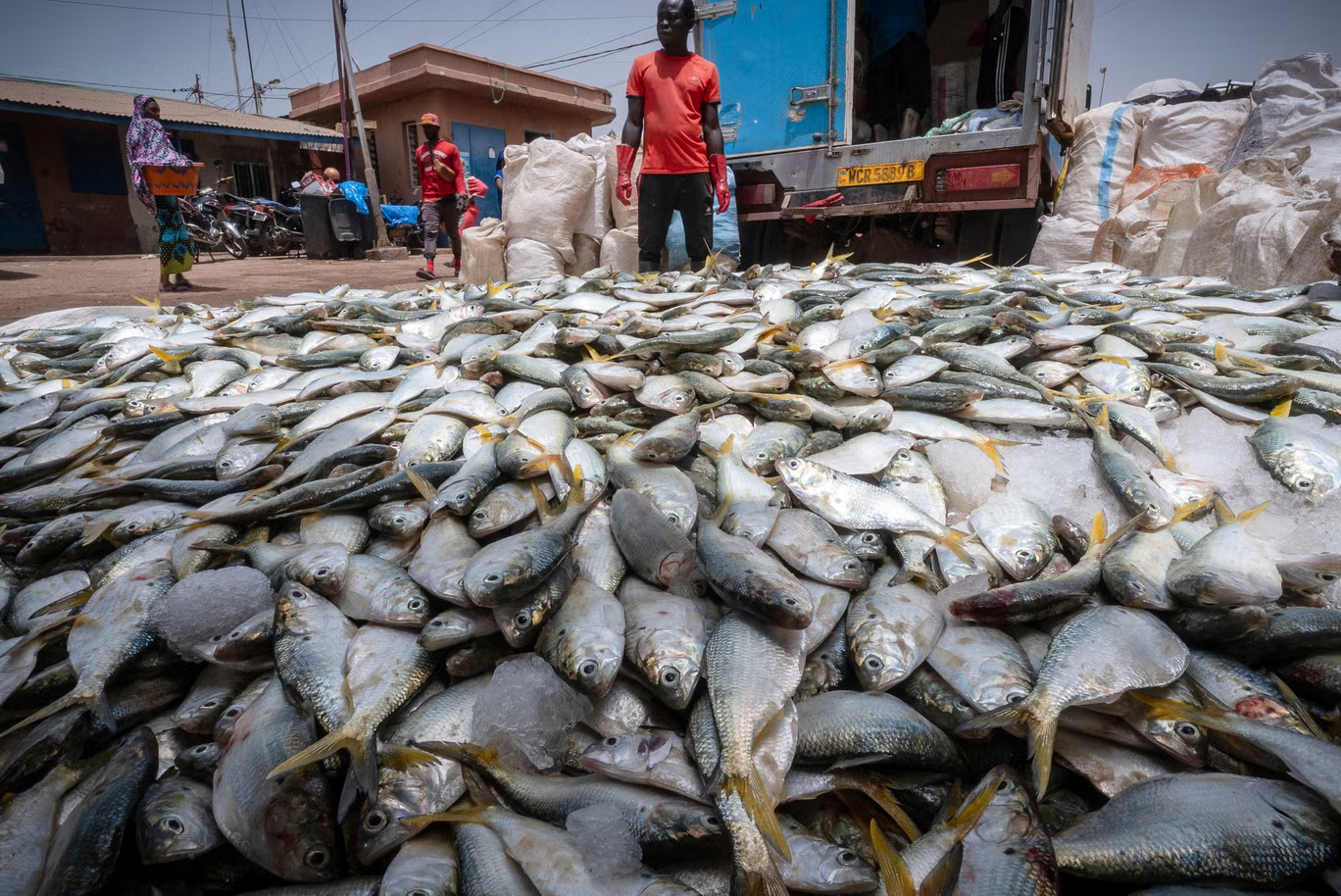
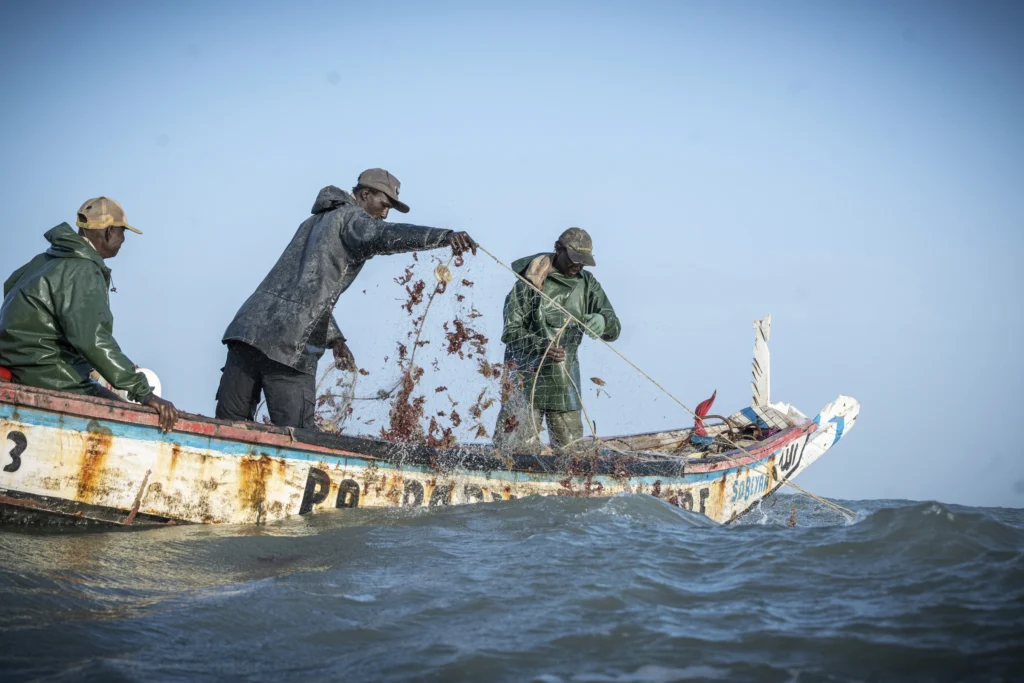
At dawn in the coastal town of Gunjur, wooden pirogues push out into the Atlantic, their small engines humming over the crash of waves. For generations, Gambian fishermen have depended on these waters to feed their families and supply local markets. But now, many return to shore with almost nothing.
The problem is not a lack of skill or effort. Huge foreign trawlers—mostly Chinese, Turkish, and Senegalese sweep through the same waters. Their heavy nets pull in not only the bonga and sardinella that Gambians eat daily, but also the juvenile fish necessary to sustain stocks. When local fishermen try to stand their ground, clashes can turn violent.
“You see them cutting your net, but you cannot do anything, because two men cannot go against 20 to 30 men in the sea,” said Famara Ndure, a fisherman in Gunjur.
For fishermen here, this is an affront to their culture, livelihood, and survival. Gambia’s small-scale fishing industry supports hundreds of thousands of people and supplies the country’s cheapest source of protein. If catches continue to fall, many fear widespread hunger and job losses.
Locals have begun calling it “the sea war.” Nets ripped apart by steel-hulled ships. Canoes tipped over in clashes. Foreign vessels are pushing into zones reserved for artisanal boats.
Government officials and NGOs have documented numerous incidents and several trawler detentions in recent years. Fishermen insist the government could and should do more. The lack of action, they say, suggests the odds are already stacked against them.
The Beginnings
More than a decade ago, the Gambian government froze industrial fishing licenses. Then-President Yahya Jammeh argued that foreign trawlers were depleting fish stocks and pushing small-scale fishermen out of their own waters. The embargo was meant to give fish populations time to recover and protect artisanal crews, who supplied most of the country’s fish.
The decision was backed by a 2006 the Food and Agriculture Organization of the United Nations (FAO) assessment, which warned that small pelagic fish like bonga and sardinella were under severe pressure in the region. Local fisher cooperatives welcomed the freeze, saying it gave them much-needed “breathing space” after years of competing with massive trawlers.
The policy ended in 2017. President Adama Barrow’s new government reopened Gambian waters to foreign fleets, citing potential revenue gains. Officials issued dozens of licenses within the first year and announced millions of dalasi in new earnings from fees, promising that industrial vessels would bring jobs, improve food security, and boost national growth.
Instead, artisanal fishermen say it brought back their worst fears, the return of trawlers and escalating clashes at sea.
Brothers Against Brothers
To ease criticism, the Gambian government requires industrial vessels to hire a percentage of local crew members. Officials framed it as a way for Gambians to benefit directly through jobs and wages. Young men from fishing villages can earn $200–$300 a month, four to five times what they might make onshore.
But rather than bridging divides, the policy has deepened them. Fishermen who join foreign vessels are branded “traitors” by their peers. In communities where trawlers are seen as the enemy, Gambians working on board are accused of siding with outsiders.
Violence sometimes follows. Rival artisanal fishermen, angered by lost catches or destroyed nets, have clashed with compatriots returning from industrial trawlers.
Kawsu Leigh was among two Gambian crewmen badly burned last year when angry locals hurled flaming stones at an Egypt-flagged trawler they were working on. While one fisherman now stands trial for the attack, Leigh struggles to rebuild his life, with most of his earnings consumed by medical expenses.
“I moved here to hustle for my family. I had this accident. Yeah, I think my life is finished,” Leigh said. Seaman work is like prison, but we call it a civilized prison. This job, no respect is there. We are going to risk our lives. I have two brothers, two sisters. If I don’t do anything, they will not have anything.”
Fish, Food, and Survival
This crisis runs deep. Fish is a lifeline for this small West African nation of 2.7 million people. According to the FAO, about 50 percent of Gambians’ animal protein intake comes from fish, one of the highest ratios in sub-Saharan Africa.
But catches have plummeted. A 2023 Greenpeace Africa report found that sardinella stocks in West African waters have dropped by over 30 percent in the past decade. Local markets tell the story: in Serrekunda, Gambia’s busiest, bonga fish prices have risen by at least 50 percent, pushing a staple out of reach for many low-income families.
“A kilogram of ladyfish and barracuda now costs $5,” said Abdourahman Ceesay, a 28-year-old fish vendor. “Some fish weigh five or six kilograms, meaning that a customer has to shell out $20, unbearable for an ordinary person.”
Adja, a widow in her forties, began smoking fish to support her five children after her husband’s death. She primarily smokes bonga and sardinella, but heavy fishing by factory canoes and foreign trawlers has made these species scarcer and more expensive, leaving her profits unstable.
“I still have hope… I will see whether I can keep doing this. For the past four months, I have not seen any positive change; the situation is getting worse. There are not enough fish,” Adja said.
The economic toll is stark. The artisanal fishing sector employs over 200,000 Gambians directly or indirectly—nearly 10 percent of the workforce. With declining stocks, many are struggling.
“Some of our young men are leaving for Europe,” said Lamin Jassey, an activist with the Gunjur Conservation and Ecotourism Association (CETAG). “They don’t see any future here.”
Experts note that collapsing fishing livelihoods are a key driver of irregular migration from coastal Gambia. In many villages, families openly encourage sons to “try the backway” across the Sahara rather than face unemployment at home.
Factories and Fishes
Reopening the seas coincided with granting licenses to fishmeal plants largely owned by Chinese companies. Factories such as Golden Lead in Gunjur, JXYG in Kartong, and Nassim in Sanyang began buying huge volumes of bonga and sardinella to grind into fishmeal and oil for export to aquaculture farms in Europe and Asia.
While initially welcomed for jobs and infrastructure, the plants drew criticism for pollution and for competing with Gambians for the same small pelagic fish they eat daily.
A 2021 Changing Markets and Greenpeace investigation found that fishmeal factories were taking large shares of small pelagic landings—one report estimated a single FMFO plant accounted for roughly 40 percent of The Gambia’s reported catches in 2016.
Communities also complained that factory waste and odors fouled lagoons and beaches, damaging local tourism. “The smell was unbearable, and the water turned black,” said Lamin Jassey of CETAG.
A 2023 Amnesty International report found that several key fish species are overexploited, with industrial trawlers and fishmeal factories driving much of the pressure. When plants cannot process contracted catches, fishermen often dump unsold fish back into the sea, as documented in Sanyang. The report also raised concerns about untreated wastewater from the Nessim fishmeal factory, which has faced community protests, fines, and temporary closures before being allowed to reopen.
Who Benefits?
Barrow’s administration faced pressure to revive the economy after two decades of isolation. International investors, particularly from China and Turkey, viewed fishing as a revenue stream, and the government opened its doors.
Fishing licenses, permits, fines, and landing fees generated about $3 million for the government in 2023—a significant sum for a small economy.
“The fisheries sector is another important source of revenue for the government and food for the population,” President Barrow said, presenting the industry as a success story.
Yet the distribution of benefits is strikingly unequal. While the state earns upfront revenue, foreign fleets and fishmeal companies reap the bulk of profits once Gambian fish are exported. Coastal communities face rising fish prices, making basic protein less affordable.
In practice, what the government hails as economic opportunity is, for many Gambians, experienced as deepening inequality.
The Curse of Enforcement
Enforcement is weak. Gambia’s navy is under-resourced and relies on international NGOs and satellite partners to monitor illegal incursions. Prosecutions are rare, and many violators return to fishing waters within weeks.
Neighboring Senegal faces similar challenges. Authorities seize Chinese trawlers accused of illegal fishing, but hundreds operate with impunity. Mauritania signed a multi-million-dollar fishing agreement with the EU, criticized as “legalized plunder.” The Gambia, a small nation between powerful neighbors, has fewer bargaining chips.
International agreements further complicate matters. China, a major investor in roads, bridges, and hospitals, often ties trawler licenses to broader development deals. Meanwhile, European markets drive demand for Gambia’s fishmeal, which feeds aquaculture farms in Spain, Norway, and China.
Environmentalists warn this is a dangerous paradox: Europe’s fish farms thrive on protein extracted from West Africa, while Gambians struggle with food insecurity. “It’s a direct transfer of nutrition from the poor to the rich,” said Dr. Rashid Sumaila, a fisheries economist at the University of British Columbia.
Fighting for the Future
On the ground, communities are organizing resistance. In Kartong, near Senegal, residents staged protests in 2023 against a Chinese-owned fishmeal factory accused of polluting the coast and depleting local stocks. After weeks of unrest, the government suspended the factory’s license.
Civil society
Groups are also pushing for reform. “We protested because we knew our community was being sacrificed for profits,” said Lamin Jassey.
Some activists look to models elsewhere: Ghana has introduced closed seasons to let fish stocks recover, while Senegal experiments with community-led co-management of fishing zones. Mauritania briefly banned fishmeal plants in 2017 before backtracking under industry pressure.
A few resilience efforts are taking shape in Gambia. Community groups in Gunjur run awareness campaigns on sustainable fishing, and cooperatives experiment with mangrove restoration to protect breeding grounds. Experts say such approaches, combined with stronger enforcement and policy, could balance livelihoods and conservation.
“It is possible,” said Lamin. “What is missing in Gambia is political will.”
For now, fishermen in Gunjur continue their daily struggle, heading out in predawn darkness against daunting odds. Onshore, women wait by the smokehouses, hoping for enough catch to keep their families fed.
 French
  English